
Your three-year-old is screaming in the middle of NTUC because you said no to candy. People are staring. You’re crouched down trying to stay calm, but inside you’re wondering: Is this normal? Why does my child fall apart over something so small?
Here’s the thing most parents don’t realise. A meltdown like that isn’t bad behaviour. It’s a brain still learning how to handle overwhelming emotions it doesn’t have words for yet. Children aren’t born knowing how to deal with anger, disappointment, or fear. They have to learn it, slowly, the same way they learn to walk or talk.
That learning has a name: emotional development. And once you understand how it actually works, those tantrums, the clinginess, the sudden tears over nothing, start to make a lot more sense.
In this guide, we’ll break down what emotional development in children really means, what to expect at each age, and simple things you can start doing today to help your child feel calmer, kinder, and more confident, both at home and in school.
What Is Emotional Development?
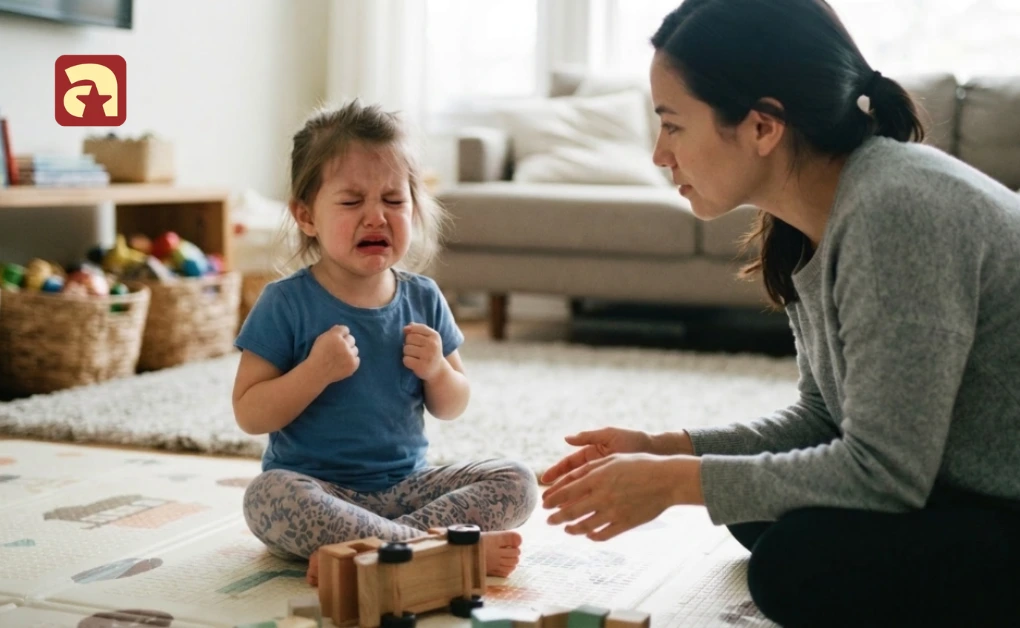
Think of emotions like a muscle still building strength. A baby has it, but not the control to use it well yet. Naming a feeling, calming down, waiting for a turn. None of that comes naturally. It’s learned, slowly, through experience.
Emotional development in early childhood is simply a child learning to understand what they feel, put it into words without falling apart, and notice that others have feelings too. There’s no single day it clicks. It happens in pieces, usually messy ones.
That’s why emotional development rarely looks impressive at the moment. A three-year-old throwing a toy isn’t failing at anything. She’s still figuring out a feeling too big for her, and the fact that she’s trying at all is more progress than it looks.
Why It Matters More Than Grades (Especially in Singapore)
In Singapore, the pressure starts early. Flashcards before preschool, tuition before primary school. You’ve probably felt that quiet worry too: Is my child falling behind?
But here’s what most enrichment centres won’t tell you: emotional intelligence in children predicts long-term success better than IQ does.
- IQ helps your child solve the problem.
- EQ helps your child stay calm when the answer is wrong, ask for help, and try again without giving up.
A child who’s sharp but crumbles under pressure often struggles more than one who’s average in class but handles setbacks well. The kids who do best long-term aren’t always the smartest. They’re the ones who can sit through frustration, work with classmates they don’t click with, and recover after a rough day.
Worksheets and assessment books still matter. Just don’t let them crowd out the other half of growing up. At Amazing Star, our Montessori approach is built around exactly this balance, giving your child the academic foundations they need while making sure emotional growth never gets left behind.
The 5 Building Blocks of Emotional Development
Every child’s social and emotional development rests on five core skills. Think of them as the foundation everything else gets built on.
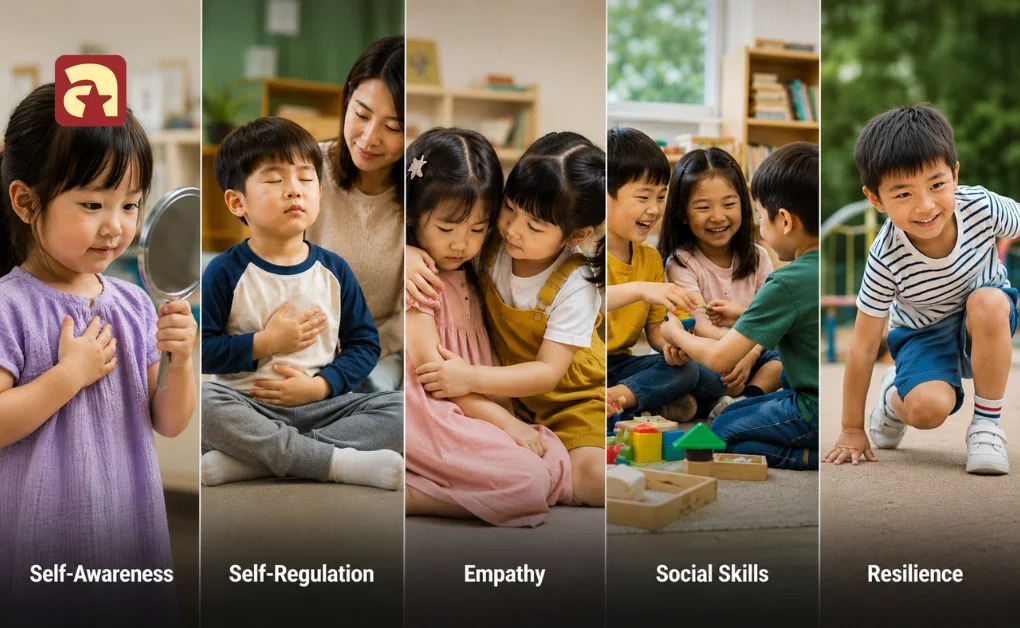
1. Self-Awareness (knowing what you feel)
This is the starting point. Before your child can manage a feeling, they need to know what it is. A toddler who says “I’m mad” instead of throwing a toy is already further along than you’d think.
2. Self-Regulation (calming down)
This is the hardest one, even for you as a parent. It’s the ability to feel upset without acting on every impulse that comes with it. Taking a breath instead of hitting. Walking away instead of screaming. This skill also takes the longest to develop, so patience matters more than correction here.
3. Empathy (caring about others)
Around age 3 or 4, your child starts noticing when a friend is sad or hurt. That’s empathy switching on. It’s also what stops bullying before it starts.
4. Social Skills (making friends)
Sharing, taking turns, reading the room. These come from watching and practising, not from being told to “be nice.” Playdates matter more than they get credit for.
5. Resilience (bouncing back)
Your child will fall, lose a game, and get left out once in a while. Resilience is how fast they recover and try again instead of giving up completely.
What to Expect at Every Age: Is My Child on Track?
Every child moves at their own pace, but here’s a general guide so you know what to expect.
Infants & Toddlers (0–2 years)
This is where toddler emotional development really kicks off. Babies cry to show distress and smile to show comfort. By age two, toddlers start having tantrums because big feelings arrive long before the words to explain them do.
Preschoolers (3–4 years)
Emotional development in preschoolers at this stage starts to become more visible. Your child can now name basic feelings like happy, sad, or angry. Step into any classroom at a preschool in Singapore, and you’ll often see these skills beginning to emerge, children playing together, noticing when a friend is upset, and sometimes offering a hug or comforting gesture.
Kindergarten (4–6 years)
By now, most children can wait their turn, follow simple group rules, and handle small disappointments without falling apart. This lines up closely with what MOE’s Nurturing Early Learners (NEL) framework expects for this age group, building confidence, curiosity, and the ability to relate well to others.
Want to know when each preschool stage begins? Read our guide to the right preschool age in Singapore.
Signs Your Child Is Developing Well Emotionally
If you’re not sure whether your child is on track, here are some everyday signs worth noticing:
- They can name a feeling, even simply (“I’m sad,” “I’m mad”)
- They settle down after a meltdown, even if it takes a little while
- They show concern when someone else is upset
- They can play with other kids without constant conflict
- They bounce back after losing a game or being told “no”
- They ask for help instead of giving up right away
If you’re seeing even a few of these, your child is doing just fine. Emotional growth isn’t about perfect behaviour. It’s about steady progress, even on the messy days.
Common Struggles Singapore Parents Quietly Worry About
You’re not the only one carrying these worries. Most parents just don’t say them out loud.
- Academic pressure starting too early: Tuition before Primary 1, assessment books before they can read fluently. It’s common here. But pushing academics too early means crowding out the experiences that actually shape who your child is growing up to be, not just what they know.
- Busy parents, helpers, or grandparents as main caregivers: With both parents working, many children spend their days with a helper or grandparent. That’s not a failure on your part. Staying involved in small, daily ways often matters more than being there every hour.
- Too much screen time, not enough real play: A tablet keeps things calm in the moment, but it doesn’t teach a child how to share, lose gracefully, or read a friend’s expression. Those lessons only come from being around other people.
- Growing up with multiple languages and cultures: Many Singaporean kids juggle English, Mandarin, Malay, or Tamil at home, sometimes with different expectations from each side of the family too. That mix isn’t a problem by itself, but it can make it harder for a child who’s still learning to put feelings into words.
5 Simple Things Parents Can Do at Home
You don’t need a course or a fancy method. These are simple, everyday activities to promote social and emotional development, small, repeated actions that matter more than anything else.
- Name the feeling (“I see you’re frustrated”): Instead of saying “stop crying,” try naming what they’re feeling. It helps your child connect the word to the emotion, which is the first step toward managing it.
- Stay calm yourself; kids copy you: Children learn how to handle strong emotions by watching you handle yours. If you yell when you’re upset, that’s the lesson they pick up too.
- Read storybooks about feelings together: Stories about characters who feel scared, angry, or left out give your child language for emotions they don’t yet know how to explain.
- Praise effort, not just results: Instead of “you’re so smart,” try “you worked really hard on that.” It teaches your child that trying matters, even when things don’t go perfectly.
- Make time for unstructured play: Free play with no rules or instructions is one of the best preschool social emotional development activities you can offer at home. It builds patience, creativity, and the chance to practise handling small conflicts on their own.
When to Get Extra Support
Most ups and downs are normal. But if your child has frequent meltdowns past age 5, avoids playing with others, or just can’t settle down no matter what you try, it’s worth talking to your polyclinic or paediatrician.
They can check things out and, if needed, connect you with programmes like EIPIC (Early Intervention Programme for Infants and Children), which support children who need a little extra help along the way.
Asking for help doesn’t mean you’ve failed. It means you noticed something early, and that’s exactly what a parent should do.
Conclusion
Your child doesn’t need a perfect parent. They need one who keeps showing up, even after the meltdown in NTUC, even on the days patience runs out.
Emotional development in children isn’t built in one big lesson. It’s built in a thousand small moments, the hugs, the “I see you’re upset,” the quiet recovery after a hard day. You’re already doing more of it than you think.
At Amazing Star, our teachers at Preschool Bukit Panjang, Preschool Choa Chu Kang, and Preschool Yishun see these moments every day as part of the learning and play that shapes children’s emotional growth.
FAQs
1. What is the difference between social and emotional development?
They’re closely linked but not the same thing. Emotional development is about how your child understands and manages their own feelings. Social development is about how they relate to and get along with others. In practice, the two grow together, which is why you’ll often hear them talked about as one thing: social and emotional development.
2. How does play help with emotional development in children?
Play is actually where most of the real emotional learning happens. When children play together, they practise sharing, taking turns, handling losing, and working through small disagreements without a parent stepping in every time. Those moments build more emotional skill than any worksheet can.
3. Can too much screen time affect my child’s emotional development?
Yes, and it’s worth paying attention to. Screen time isn’t harmful in small amounts, but when it replaces real interaction and play, children miss out on the face-to-face experiences that build empathy, patience, and social awareness. Those skills only come from being around real people.
4. At what age should a child be able to control their emotions?
Full emotional control is honestly something most adults are still working on. But by age 4 or 6, children should be able to calm down after a meltdown with some support, wait their turn, and begin to name what they’re feeling. If your child is past that age and still struggling significantly, it’s worth a conversation with your paediatrician.
5. How do I know if my child has an emotional development problem?
Most ups and downs are normal. But if your child frequently can’t calm down even with support, avoids other children consistently, or seems unable to name or manage any feelings well past age 5, those are signs worth getting checked. Early support makes a real difference, so it’s always better to ask than to wait and see.