
Your two-year-old just sorted their crackers by shape without anyone asking them to. Sound familiar?
Most parents see these small moments and smile, then move on. What they do not realise is that those moments are exactly where early math begins. Not in a classroom. Not with flashcards. Right there at the snack table.
The tricky part is that it does not feel like enough. You see worksheets at other kids’ playgroups. You read about structured learning programs. And suddenly a few crackers sorted by shape feels like you are leaving something on the table.
You are not. The everyday moments already happening in your home are more powerful for early numeracy than any worksheet. You just need to know which ones to lean into and how to make them count.
These seven numeracy activities for toddlers show you exactly that. No preparation needed, no special materials, just your toddler and the stuff already around you.
Fun Math Activities for Toddlers in Singapore
1. Counting everyday objects together
Start with things your toddler already loves. Count the grapes on their plate, the blocks in the pile, or the steps going up to the door. Point to each one as you say the number out loud, and gently encourage them to count along with you.
This kind of counting teaches something important: that numbers stand for real amounts, not just words in a sequence. When your toddler counts four strawberries and then eats them one by one, they are connecting the word “four” to something they can actually see and touch.
Quick tip: Let your child take the lead. If they skip a number or lose track, just model it calmly and carry on. Correction through example works far better than stopping to correct.
2. Sorting and grouping everyday items
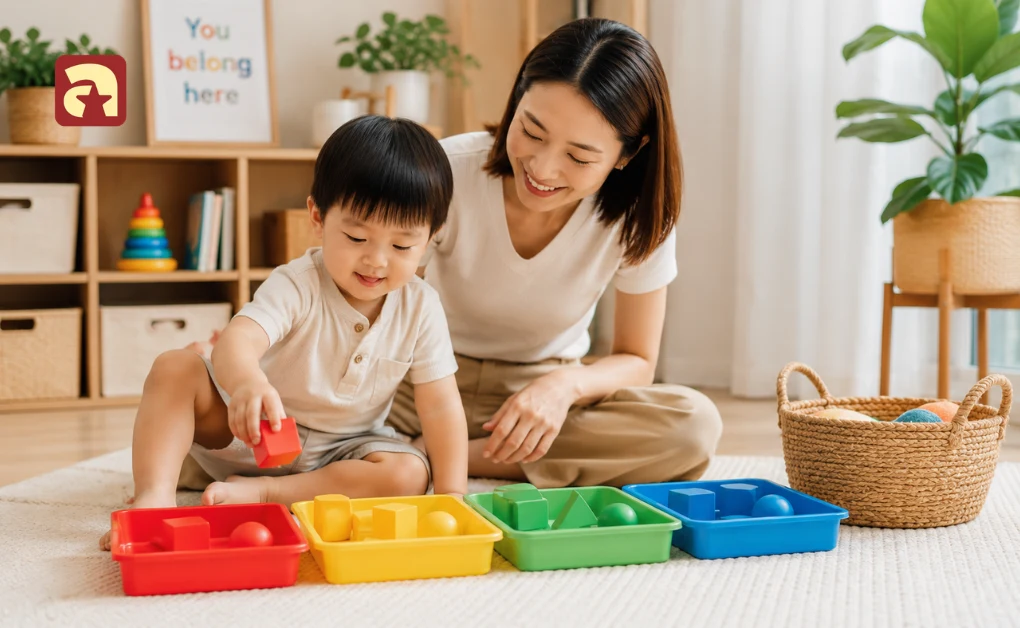
Gather a small mix of household items and invite your toddler to sort them. Socks by size, blocks by colour, toy animals by type. Even sorting groceries after a trip to the supermarket works perfectly.
Sorting teaches young children to notice what things have in common and how they differ. This kind of thinking sits right at the heart of early math and logical reasoning, and it can happen through something as simple as asking “Can we find all the red ones?”
Many simple Montessori activities for toddlers at home use the same idea, encouraging children to sort, compare, and organise everyday objects through hands-on play. These simple experiences build the foundations of logical thinking and grow naturally out of everyday moments, even a pile of mismatched socks.
3. A number treasure hunt around the house
Write numbers on small cards and hide them in different spots around your home. Ask your toddler to go and find them, then say each number out loud when they do.
Your toddler learns through movement. When their body and mind are both involved, memory and engagement go up. Finding a card tucked behind a cushion feels like a real adventure, and that sense of discovery makes the number stick.
Every number they find feels like something they earned. That feeling is what keeps them wanting to do it again.
Quick tip: Cheer every discovery, not just the correct ones. The enthusiasm you bring to the activity shapes how your child feels about learning numbers.
4. Shapes and simple patterns
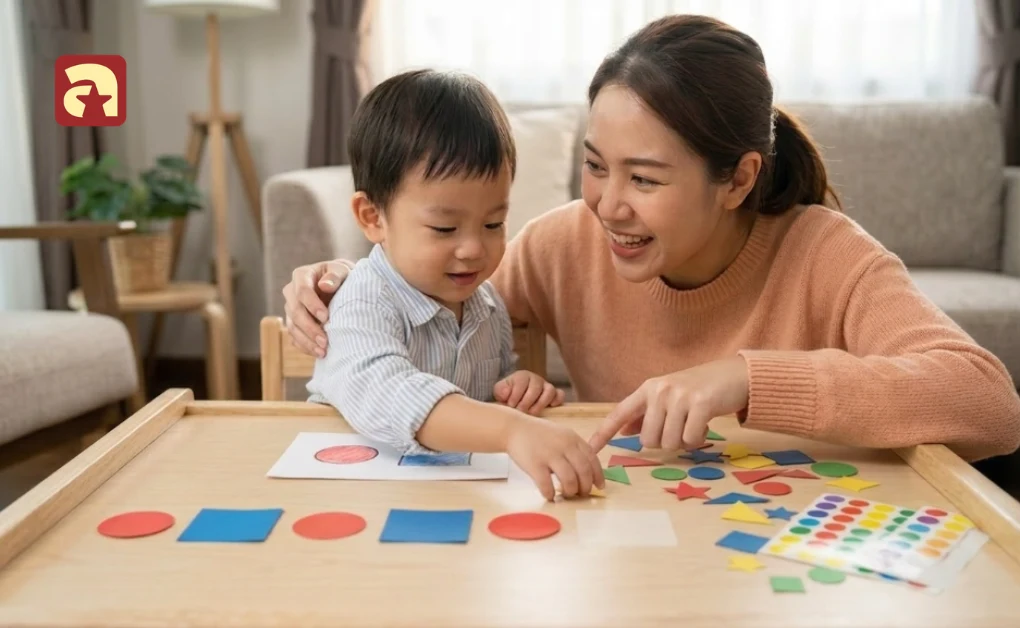
Use blocks, stickers, or paper shapes to build simple repeating patterns, such as circle, square, circle, square. Lay out the first few and then ask your toddler what should come next.
Spotting patterns is one of the most important early numeracy skills for toddlers to develop. It trains your child to think ahead, to look for order, and to predict, all of which feed directly into later math learning.
Toddlers often notice patterns around them without realising it, in the tiles at the playground, the stripes on a shirt, or the repeated design on a favourite toy. Drawing attention to these moments helps your child see that math is already everywhere. You can also try building a pattern with snacks or small toys and asking, “What do you think comes next?”
5. Simple number games and matching cards
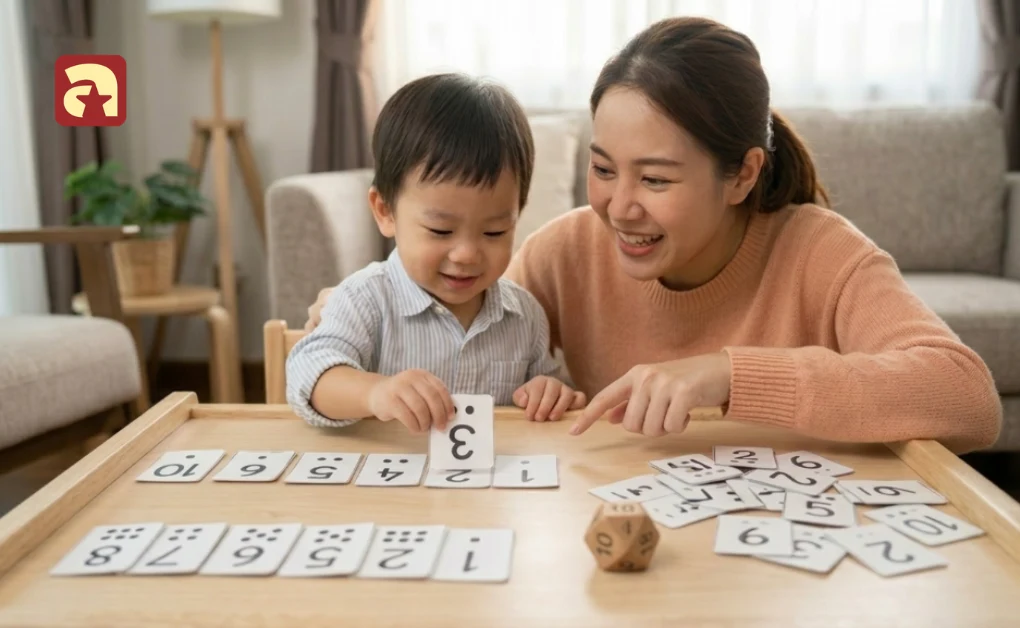
Toddler number games are some of the easiest home learning tools you can use in Singapore without spending much at all. Number-matching games, memory cards, or simple board games designed for toddlers bring math into play in a relaxed, social way. Homemade cards work just as well as anything bought from a shop.
Beyond the numbers themselves, games teach your toddler to wait their turn, follow simple rules, and keep going even when things do not go their way. These are skills that support both learning and emotional development.
Keep the focus firmly on fun. When your child feels at ease, they stay curious and willing to try again.
6. Cooking and measuring together
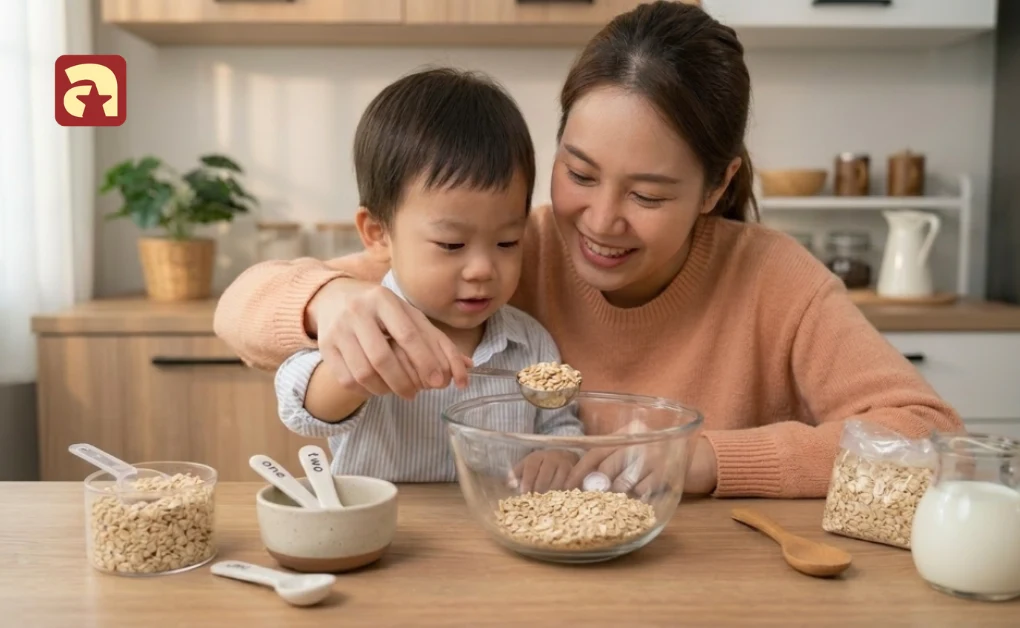
Let your toddler help with simple food preparation. They can scoop, pour, and count out ingredients while you talk through what you are doing together.
Measuring introduces ideas like more, less, full, and half in a way that young children can actually feel and see. It is one of the richest numeracy activities you can do together, and it is already sitting in your kitchen.
Stirring batter, counting scoops of oats, or filling a cup to the top gives math a texture and a taste. That sensory connection makes concepts far easier to remember. Slow down as you go and say what you are doing out loud. “We need two spoons of sugar, let’s count them, one, two.” Simple, repeated language like this builds understanding quietly over time.
7. Counting songs and number rhymes
Sing number songs together and encourage your toddler to clap, jump, or act out the words as you go. Bath time, car rides, and the walk to the park are all perfect moments for this.
Music and movement work together to make learning stick. When children feel the rhythm of a counting song, they are not just memorising words. They are building a feel for number sequences in a way that feels fun rather than forced, and that positive feeling is what carries their confidence into more formal learning later on.
Bonus: Take the counting outside
Counting does not have to stay indoors. Count the steps on the slide, the swings in the playground, or the lampposts on the way to the bus stop. Arrange fallen leaves by size. Spot patterns in the tiles at the void deck.
Once your toddler starts noticing numbers on lampposts and patterns on floor tiles, you will realise they were never waiting to be taught. They were already looking.
Want to know what comes next after these early experiences? This guide on what children learn in kindergarten gives a clear picture of how play-based learning at home connects to what happens in the classroom.
Home Learning Activities for Toddlers in Singapore: Simple Tips to Keep Math Fun
- Keep activities short. Five to ten minutes is plenty for most toddlers.
- Follow your child’s lead rather than pushing through when they lose interest.
- Praise effort, not just results. “I love how you kept trying” means more than “well done.”
- Weave activities into routines you already have rather than setting aside separate time.
- Repetition is not boring for toddlers. Doing the same activity across several days helps things sink in.
Conclusion
Early numeracy does not begin when a child starts school. It begins at home, in the small, everyday moments that you are probably already having with your toddler without even realising it.
When your child counts, sorts, explores patterns, and measures things as part of normal daily life, they build confidence with numbers gradually and without pressure. That quiet, steady foundation is what makes formal learning feel manageable and even enjoyable when the time comes.
You do not need to turn your home into a classroom. You just need to notice the moments that are already there and make the most of them.
If you are looking for a preschool in Singapore that weaves numeracy and play-based learning into every part of the day, visit one of our centres and see how we approach early childhood education.
FAQs
1. When should I start doing numeracy activities with my toddler?
You can begin as early as 12 to 24 months. Toddlers at this age learn best through play, observation, and simple conversations rather than structured lessons. Everyday interactions are more than enough to get started.
2. Does my toddler need to count to 10 before doing these activities?
Not at all. Early math is about understanding what numbers mean, not reciting them in order. Knowing that “two” means two actual objects matters far more than saying numbers perfectly. Real understanding always comes before memorisation.
3. Will doing these activities at home actually help later on?
Yes. Sorting, comparing, spotting patterns, and counting in everyday life build the thinking skills that form the foundation for school math. Children who have these early experiences tend to feel more comfortable and confident when formal learning begins.
4. My toddler gets distracted quickly. How long should these activities last?
Keep them short, around five to ten minutes. Frequent, playful sessions repeated over time are far more effective than long structured ones. Stopping while your child is still enjoying themselves keeps the experience positive and makes them more likely to want to do it again.
5. What if my toddler does not seem interested in numbers yet?
That is completely normal. Every child develops at their own pace. Keep offering simple, enjoyable experiences and let your child engage when they are ready. Interest tends to grow naturally with repeated, low-pressure exposure over time.