
You have maybe 15 minutes. The teacher is sitting across from you. And suddenly, every question you planned to ask disappears from your head.
You walk out knowing your child is “doing fine.” But fine compared to what? Fine in which subjects? Fine emotionally, or just managing?
For Singapore parents of young children, parent-teacher meetings carry extra weight. The early years move fast. What you learn in that short conversation about your child’s development, habits, and happiness can shape how you support them at home for months to come. Yet most parents leave without the answers they actually needed.
This guide gives you 9 specific parent-teacher meeting questions that help you get past vague answers and see the full picture of how your child is doing, academically, socially, and emotionally.
Why PTMs Matter More Than Most Singapore Parents Realise
Teachers in Singapore schools manage classrooms of 30 to 40 students. Each child gets limited one-on-one attention during the school day. Your parent teacher meeting slot, as brief as it is, is one of the few moments where the conversation is entirely about your child.
It is also a chance to connect two worlds. You see your child at home, how they react when asked to try something new, how they handle moments of frustration, what drains them and what lights them up. Your child’s teacher sees something completely different. They notice how your child works through problems, whether they ask for help or stay quietly stuck, and how they get along with their classmates.
Those two views together give a much clearer picture than either of you has alone. But only if you know what to ask during parent teacher meeting time.
At Amazing Star, a Montessori preschool in Singapore, teachers are trained to share exactly these kinds of observations with parents at every meeting.
9 Questions to Ask at Your Next Parent-Teacher Meeting in Singapore
1. How is my child approaching their learning, not just their results?
Report cards tell you the outcome. This question tells you the process, which matters far more in the long run.
Two children can do the same activity in class for completely different reasons. One understood what they were doing and why. The other copied the steps without really getting it. In the early years, building real understanding matters far more than just getting the right answer. Good habits formed now carry your child all the way to primary school and beyond.
Ask specifically:
- Does my child ask questions when something doesn’t make sense, or do they just push through?
- Do they try different approaches when they get stuck, or give up quickly?
- Are they curious and engaged, or just going through the motions?
The answers tell you whether your child is building the kind of thinking that works when things get harder, or whether they need a different kind of support at home.
If you are curious about what children are expected to learn at this stage. Read our guide on what children learn in kindergarten to get a clear picture.
2. What patterns do you notice in what they’re naturally good at?
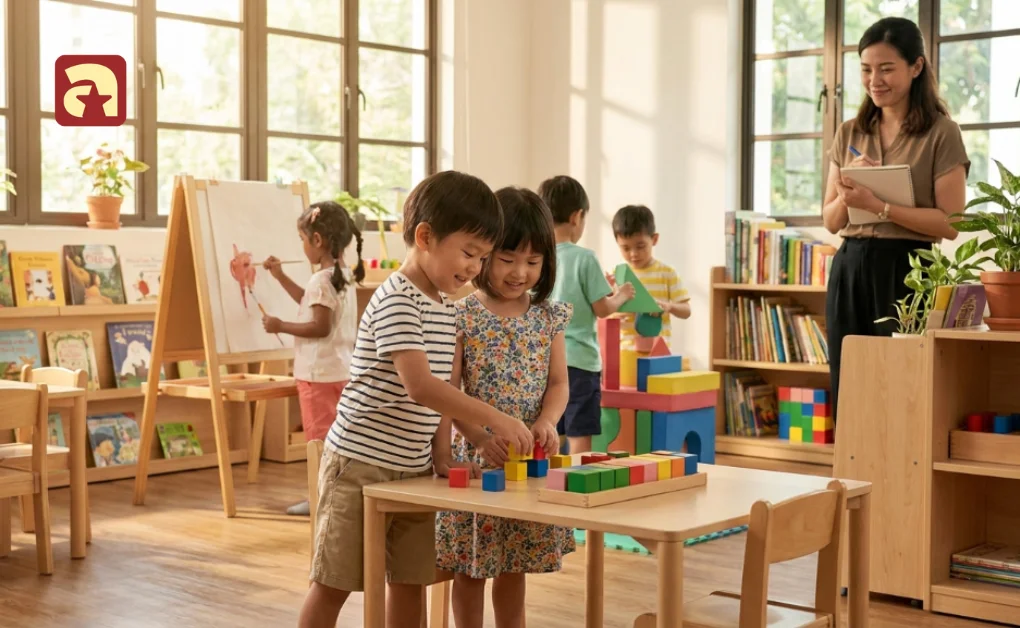
Strengths in the early years are not always what parents expect. And they go far beyond what happens during structured activities.
A teacher might notice your child consistently encourages quieter classmates during group play. Or that they are the first to spot something different in a story. Or that they ask questions that go beyond what has been taught. These are real strengths, and they are easy to miss if you are only watching for what your child can and cannot do yet.
Knowing your child’s natural strengths helps you support them at home in ways that feel encouraging rather than pressuring. It also gives you a fuller picture of who your child is becoming, not just where they are right now.
3. Where exactly does my child find things difficult?
“Needs improvement” is feedback that helps no one. You need specifics.
Push gently for detail:
- Is it a gap in understanding, or a gap in attention?
- Do they struggle because they do not get the concept, or because they find it hard to sit still and focus?
- Do they find it harder to get started on something, or to see it through to the end?
In the preschool years, catching these things early makes a real difference. A child who understands but gets easily distracted needs different support than one who is genuinely struggling with a concept. Getting this clarity means you are not guessing at solutions. You are fixing the right thing.
4. What does my child do when they don’t understand something?
This might be the most revealing of all the parent teacher questions on this list.
How your child reacts when they are confused tells you a lot about their social and emotional learning, how confident they feel, how comfortable they are with making mistakes, and what kind of learner they are becoming.
Listen for whether your child:
- Puts up their hand and ask for help
- Stays quiet and waits, hoping it will make sense later
- Gets frustrated and stops trying
- Pretends they understand and moves on
Children who are afraid of looking wrong in front of their classmates often go quiet rather than ask. In a school environment like Singapore’s, this slowly hurts their confidence over time. Knowing this early lets you help them feel safer about making mistakes at home, before it becomes a hard habit to break.
5. How do they fit into group work and class dynamics?

Individual work shows what your child knows. Group work shows how they operate.
Most preschools in Singapore and MOE schools regularly include group tasks and project-based learning. How your child does in those settings says a lot about their social confidence and how well they communicate.
Ask:
- Do they take the lead or tend to follow?
- Do they listen to others, or do they take over?
- Are they included easily, or do they sometimes seem left out of the group?
This is not just about social skills. It connects directly to learning. Children who feel confident in group settings join in more, ask more questions, and remember more. If your child is pulling away from others or finding it hard to work in a team, it is worth knowing now.
6. What one or two changes would make the biggest difference right now?
Do not ask how to “improve overall.” That question gets you a list too long to act on.
Instead, ask the teacher to point out the most useful change, the one small shift that would make the biggest difference. Good teachers can almost always spot this. It might be something like:
- Giving themselves a moment to try something before asking for help
- Joining in during group activities instead of watching from the side
- Tidying up independently after finishing an activity
These feel like small habits. But done consistently, with your support at home, they add up to real improvement. Trying to change five things at once usually means changing nothing. One focused effort, done well, beats scattered effort across everything.
7. What is my child actually like during a lesson?
It is easy to picture your child sitting quietly and paying attention. But the reality is often more complicated.
Ask the teacher to describe what a normal lesson looks like for your child. Not just their general behaviour, but how they stay involved throughout:
- Do they stay focused all the way through, or drift when things get harder?
- Do they only join in when the teacher calls on them?
- Are they mentally switched on, or just physically in the room?
Some children look well-behaved but are completely lost halfway through. Others look distracted but actually follow everything. You cannot spot this from a simple activity sheet brought home. A teacher who knows your child can tell you, and what they say might change how you support your child’s learning habits at home.
8. Have you noticed any shifts in how my child has been lately?
This question is less about current performance and more about direction. Teachers spend enough time with students to notice when something changes, often before parents do.
Ask about change, not just current behaviour:
- Has my child seemed quieter or more withdrawn than usual?
- Have you noticed any drop in effort or enthusiasm, even if grades haven’t changed yet?
- Is there anything different about how they are getting along with classmates?
In the preschool years, children go through a lot of changes quickly. Moving from Nursery to Kindergarten, adjusting to new classmates, or getting ready for the big jump to Primary 1 can all bring on stress, quietness, or a dip in confidence. These feelings often show up at school before they show up at home. Asking about change helps you catch these things early, when they are still easy to deal with.
9. What should we focus on before the next check-in, and how do we stay in touch?
The most useful parent-teacher conference ends with a clear next step, not just a pile of information.
Ask the teacher to help you decide what matters most:
- If you could tell me one thing to work on with my child at home, what would it be?
- What would good progress look like by the next time we speak?
- What is the best way to follow up, through Parent Gateway, email, or a quick message?
Information alone does not change anything. A clear next step does. Knowing the right channel also means small concerns get sorted early, not saved up for next term.
4 Common Mistakes Singapore Parents Make at PTMs
Even well-prepared parents fall into these habits. Being aware of them helps you get more out of the conversation.
- Focusing only on what your child can or cannot do yet: Skills and activities are part of the picture, not the whole story. A child who is still working on letter formation but shows real curiosity and confidence needs different support than one who breezes through activities but struggles to work with others.
- Getting defensive about feedback: When a teacher raises a difficult issue, the urge to protect your child is natural. But feedback given respectfully is useful. Treat it as a starting point, not a verdict.
- Comparing to other children: “Is she doing better than the class average?” is a less useful question than “Is she doing better than she was last term?” Your child’s progress relative to their past matters more than their rank.
- Leaving without a plan: Always end with at least one clear next step you both agree on. Without that, the conversation stays as information rather than turning into real action.
How to Turn What You Learn Into Real Progress
The PTM is only as useful as what you do after it. Here is a simple approach that works:
- Choose one or two priorities: More than that becomes too much for your child and for you. Start with what the teacher said matters most.
- Talk to your child calmly and specifically: Share what the teacher said in a kind, supportive way. Use real examples rather than vague comments. “Your teacher noticed you find it tricky to take turns, let’s practise that together” lands very differently from “your teacher says you need to improve.”
- Build one new habit at home: Small, steady changes work better than big ones. Reading together before bed. Letting your child tidy up their own things. Giving them a moment to try something on their own before jumping in to help. One encouraging word each day.
- Notice progress out loud: When your child improves, even a little, say something. Children grow faster when they know someone sees their effort.
- Stay in the loop: Use Parent Gateway or email to check in with the teacher a few weeks later. A short note asking “has anything shifted?” shows you are involved and keeps the door open.
Conclusion
Parent-teacher meetings in Singapore schools are short. But the right questions make them count.
When you ask how your child learns, not just what they score, when you ask about change, not just current results, and when you leave with a clear next step, you walk away with something genuinely useful. Not just a report. A real picture of your child.
You are already doing something right by showing up and caring enough to ask. Make those 15 minutes work for your child.
If you are looking for a preschool that keeps parents closely involved every step of the way, visit one of our centres and see how we do it.
FAQs
1. What should Singapore parents prepare before a parent-teacher meeting?
Think about what you have noticed at home, changes in mood, how your child talks about school, whether they seem happy or unsettled, and anything about their behaviour or routine that has felt different lately. Write down two or three questions before you go. This helps the conversation go deeper than just general updates.
2. Do teachers notice things beyond academics?
Yes, quite a lot. Teachers watch how children handle frustration, how they treat classmates, whether they ask for help or avoid it, and whether they put in consistent effort. These daily habits often say more about a child’s growth than any single activity or assessment.
3. My child is very quiet in class. Should I be worried?
Not always. Some children learn well by watching and listening. But it is worth asking whether their quietness is a choice or a sign of worry. If staying quiet means they are missing chances to ask questions or join in, a little encouragement at home can slowly help them feel more comfortable speaking up.
4. How can I support the teacher after our meeting?
Follow through on what you agreed. Small, regular efforts at home, like reading together, practising independence in daily routines, or simply talking with your child about their day, tend to make a bigger difference than sudden big changes. If something shifts, let the teacher know through Parent Gateway or a quick email.
5. What if the feedback is hard to hear?
It is okay to feel defensive. That is a natural reaction when someone is talking about your child. Try to pause, listen fully, and ask for specific examples. Honest feedback from a teacher who cares is one of the most useful things you can get. It is not about judging your parenting. It is the clearest sign of where your child needs you most.