
Rows of desks. Silent children. Hands folded, eyes forward, waiting to be told what to do next. That was the classroom of the 1800s. One woman looked at that room and refused to accept it.
Years earlier, she had already been told no, simply for being a girl who wanted to become a doctor. She pushed through anyway. So when she saw children being taught the same way, boxed in, quieted down, she pushed back again.
That woman was Maria Montessori. Her name is everywhere today, on preschool gates, in parenting conversations, tucked into school brochures across Singapore. So who is Maria Montessori, really? Behind the name is a real story, one worth knowing before you decide if her ideas are right for your child.
Let’s start from the beginning.
Who Was Maria Montessori? Her Life and Early Story
Maria Montessori was an Italian doctor and teacher who lived from 1870 to 1952. She created a way of teaching young children that reshaped classrooms far beyond her own country. Her ideas eventually grew into what we now call the Montessori Method.
Her Childhood in Italy
Maria was born in Chiaravalle, a small town in Italy, in 1870. Her father wanted her to follow the usual path laid out for girls back then. Her mother, though, believed her daughter could aim higher. That belief mattered more than anyone realised at the time.
As a child, Maria loved numbers and puzzles. She did well in school, especially in subjects that most girls weren’t even encouraged to study. By her teenage years, she already knew she wanted a different kind of future than the one expected of her.
Becoming One of Italy’s First Female Doctors
Maria set her sights on medical school. At the time, this was almost unheard of for a woman in Italy. Professors doubted her. Classmates kept their distance. She faced obstacles most students never had to think about, simply because she was a woman in a room full of men.
She didn’t back down. In 1896, she graduated and became one of the very first women in Italy to earn a medical degree. It was a huge deal, and it opened a door she never expected.
That door would lead her somewhere she never imagined.
How the Montessori Method Was Born
Working With the Children Everyone Else Gave Up On
After becoming a doctor, Maria began working with children who had learning differences. Many people at the time believed these children simply couldn’t learn. Maria didn’t buy that.
She spent hours watching them closely. She noticed something everyone else had missed. Given the right tools and enough patience, these children could focus, learn, and grow, sometimes faster than anyone expected. It wasn’t that they couldn’t learn. They just hadn’t been taught in a way that made sense to them.
The Discovery That Changed Everything
One day, while working with a group of these children, Maria saw something that stopped her in her tracks. She had given them simple objects to touch and explore, and the children weren’t just playing with them. They were completely absorbed, quiet, and still, focused in a way no one expected.
She realised this wasn’t just true for children with learning differences. It could be true for every child, if they were given the freedom to explore instead of being boxed into a desk all day. That single realisation is really what made Maria Montessori start the Montessori system, and it became the seed of everything she built afterwards.
The First Montessori Classroom: Casa dei Bambini
In 1907, Maria got the chance to test her ideas on a much bigger scale. She opened a school in a poor neighbourhood in Rome, called Casa dei Bambini, which means “Children’s House.”
The children there came from difficult homes. Many had never been to school before. But inside that classroom, something remarkable happened. Given freedom, hands-on tools, and space to move, the children grew calmer, more focused, and eager to learn on their own.
Word about that small classroom in Rome started to spread.
What Makes the Montessori Method Special
Once you see how a Montessori classroom actually works, it’s easy to understand why so many parents and teachers swear by it.
Learning Through Play and Discovery
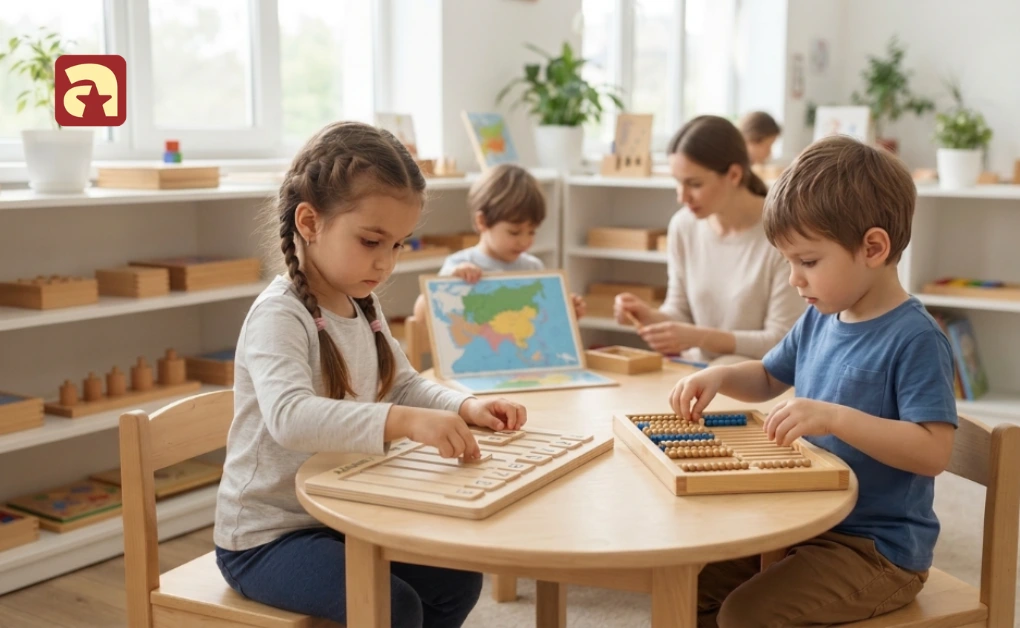
In a Montessori classroom, children aren’t handed worksheets and told to copy answers. This is where children learn through play, picking up wooden blocks, beads, puzzles, and maps to work things out on their own. A child doesn’t just hear that five plus three equals eight. They count it out themselves, using pieces they can move and rearrange.
Young children remember things better when they can see and touch them, not just listen to someone explain it.
Letting Every Child Set Their Own Speed
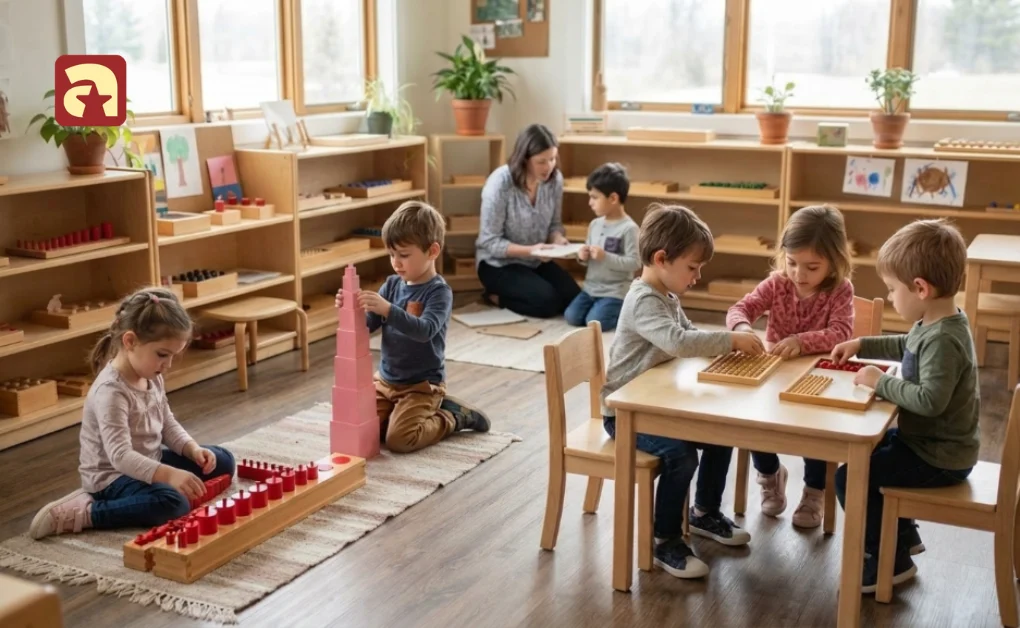
Not every child learns the same thing at the same speed, and Montessori classrooms are built around that idea. One child might spend twenty minutes on a math activity, while another finishes in five and moves on to something else entirely.
There’s no pressure to keep up with the class or rush ahead. Teachers guide from the side, stepping in when needed, but mostly staying out of the way. For many kids, this takes away the fear of falling behind, and replaces it with confidence.
Materials Designed to Teach Themselves
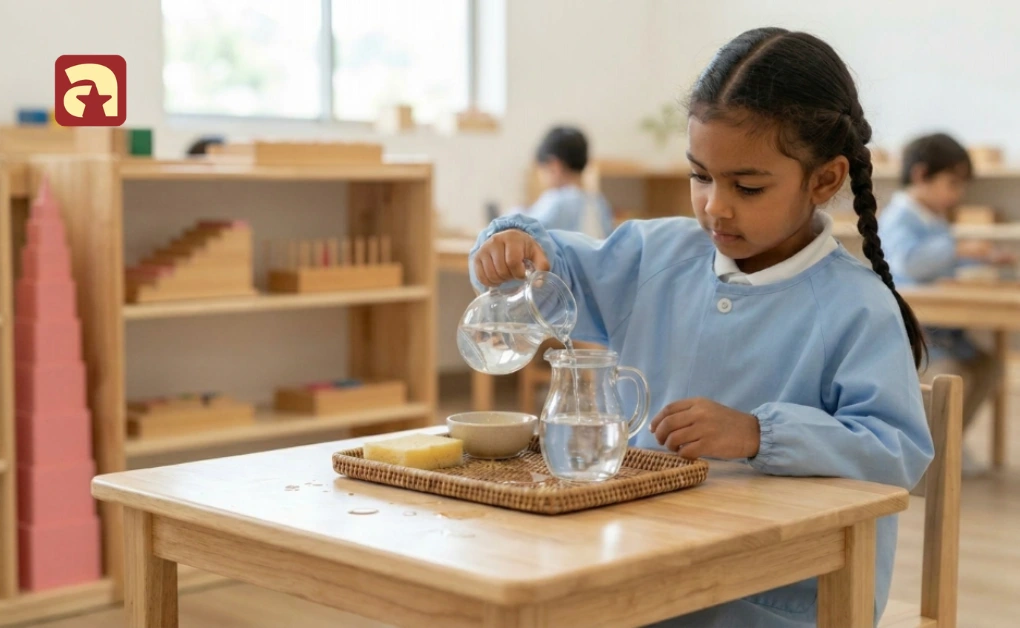
Montessori tools, like number rods, letter tiles, and pouring jugs, are built so a child can spot their own mistakes without an adult pointing it out.
Pour water into a jug and spill some, and the child sees exactly what went wrong. Try again, and they figure out the fix themselves. Over time, that habit of solving small problems alone teaches something bigger than any single skill: the child learns to trust their own thinking.
Parents who want to bring this same habit home can try these Problem-Solving Activities for Preschoolers.
How Dr. Maria Montessori’s Ideas Spread Around the World
Word about that small classroom in Rome didn’t stay in Rome for long. Visitors, teachers, and reporters came to see it with their own eyes, and what they saw was hard to ignore. Children who had barely spoken in a classroom before were suddenly reading, writing, and working on their own, calmly and without being told what to do next.
Soon, people started asking Maria to bring her method elsewhere. She travelled across Europe, then to the United States, India, and beyond, training teachers and opening new schools wherever she went. Within a few decades, Montessori classrooms existed on nearly every continent.
By the time she passed away in 1952, her method had already outgrown her. It wasn’t just one woman’s idea anymore. It had become a way of teaching that millions of children would grow up learning through, all the way into today.
Why It Matters for Singapore Parents Today
Singapore moves fast, and school often does too. Many children here go from one structured activity to the next, with little room to slow down and explore on their own terms. That’s why more parents across the island are turning to Montessori preschools as a gentler starting point.
Montessori classrooms give children something traditional settings often don’t space. Space to make mistakes, ask questions, and build real independence before the pressure of exams begins.
You’ll find Montessori preschools all over the island today, from Bukit Panjang to Yishun, all built on the same idea Maria Montessori discovered over a hundred years ago: children grow best when they’re given room to explore, not pushed to keep up.
Conclusion
Maria Montessori spent her life proving something simple: children don’t need to be forced to learn; they just need the right space to discover it on their own. From that first quiet classroom in Rome to preschools right here in Singapore, her belief in curiosity over control has shaped how millions of children grow up learning.
At Amazing Star Montessori, that same belief continues to guide everything we do. Since 2001, we’ve been following Maria Montessori’s educational approach, helping children grow into curious, capable learners who are ready not just for primary school, but for life. Our classrooms reflect the same principles of independence, exploration, and discovery that Maria Montessori first introduced in that small Rome classroom.
Come see it for yourself. Visit us at Bukit Panjang, Choa Chu Kang, Serangoon, or Yishun, and watch your child explore, ask questions, and grow in a way that feels natural to them.
Have questions, or want to know if Montessori is the right fit for your child? Get in touch; we’d love to hear from you.
FAQs
1. Did Maria Montessori have children of her own?
Yes. She had a son named Mario, born in 1898. Because she wasn’t married at the time, she had to keep this part of her life private for many years, which was unusual and difficult for a woman in her position.
2. Was Maria Montessori nominated for the Nobel Peace Prize?
Yes, she was nominated three times, in 1949, 1950, and 1951. She believed that educating children the right way could lead to a more peaceful world.
3. How old was Maria Montessori when she died?
She was 81 years old when she passed away in 1952. She spent almost her entire adult life working on and refining the Maria Montessori method.
4. Is the Montessori Method still relevant today?
Very much so. Thousands of schools worldwide, including many in Singapore, still use the Maria Montessori approach. Many modern ideas about child-led learning and hands-on education trace directly back to what she started over a century ago.
5. How many books did Maria Montessori write?
Maria Montessori wrote around fifteen to twenty books during her lifetime, along with hundreds of articles and lectures. Some of her most well-known works include The Montessori Method and The Absorbent Mind, both still read by educators today.
6. What is the Absorbent Mind according to Maria Montessori?
The Absorbent Mind is Maria Montessori’s idea that young children, especially from birth to around three years old, naturally soak up everything around them like a sponge, learning language, movement, and social skills without even trying. She believed this natural ability is strongest in early childhood, which is why the first few years matter so much for a child’s growth.