
Your child just spent two hours arranging toy cars into a traffic jam, giving each one a name, and making up a whole story about why the red one keeps cutting the queue. No flashcards, no worksheets, no tutor in sight. But something real just happened in that little brain of theirs.
Here is the thing most Singapore parents are never told. How children learn through play is one of the most researched areas in child development, and the findings might surprise you. The times your child looks like they are just playing are often when they are learning the most. Not because someone taught them directly, but because play is the way young children are built to make sense of the world. And that guilt you feel when your child is playing instead of practising? You can let that go.
So what is actually happening when your child plays, and how does it stay with them long after playtime is over? This guide breaks it all down in plain language, with real examples you will recognise from your own home.
What “Learning Through Play” Really Means (And What Singapore Schools Are Already Doing)
A lot of parents hear “learning through play” and picture children running around with no direction. That is not what it means. Play-based learning is when children build real knowledge and skills through activities they actually want to do, whether that is stacking blocks, acting out a story, or figuring out the rules of a new game with friends.
Each type of play opens a different door to learning:
- Pretend play: children step into roles and perspectives that are not their own, which is how they begin to understand people and language
- Constructive play: building and drawing with a goal in mind is how children learn to plan and follow a thought through to the end
- Physical play: running, climbing, and jumping is how the body and brain develop their connection to space, coordination, and energy through everyday gross motor skills activities.
- Social play: taking turns and sorting out disagreements is how children learn to read other people and manage their own reactions
- Rule-based play: games with structure teach children that actions have consequences and that focus produces results
Singapore’s Ministry of Education already has this built into the Kindergarten Curriculum Framework. Your child’s K1 and K2 teachers are using it in the classroom right now. Your child’s preschool is not letting them play instead of learning. They are letting them play because that is how children this age learn best.
At our preschool in Choa Chu Kang and preschool Bukit Panjang, children get daily opportunities to step into different roles through pretend play, building the language and people-understanding skills that come from this kind of imaginative play.
How Do Children Actually Learn Through Play?
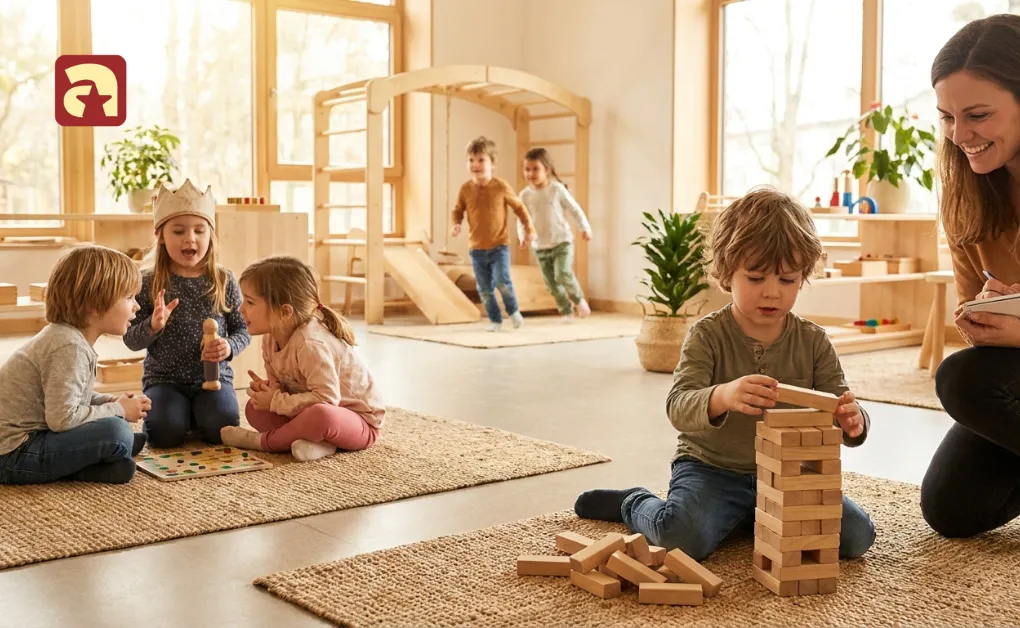
When your child plays, it does not look like learning. It looks like a mess, noise, and a lot of made-up rules that change every five minutes. But underneath all of that, their brain is working harder than most parents realise.
The learning happens through five core processes:
- Experimenting: they try something, it does not work, they adjust and try again, each attempt is the brain building a new understanding of cause and effect
- Imagining: when children create scenarios and characters, they are actively constructing language, narrative, and the ability to see things from another point of view
- Moving: physical activity sends signals to the brain that strengthen memory and help new information stick in a way that sitting still simply cannot
- Talking and negotiating: every conversation during play is the brain practising how to form thoughts, express them clearly, and respond to someone else doing the same
- Building and creating: working with their hands teaches the brain to plan ahead, stay focused, and push through when something does not go the way they expected
What makes this process even more powerful is how little it takes to deepen it. When an adult asks a simple question like “why do you think that happened” or “what would you do differently next time,” something shifts. Your child stops just playing and starts thinking out loud. You do not need to teach them during play. You just need to stay present and let them lead.
If you want to take this further, read our guide on inquiry-based learning and see how one simple question can change the way your child thinks.
What Happens in Your Child’s Brain When They Play
Now that you can see how the learning process works during play, it helps to understand what is physically happening inside the brain at the same time. Every time a child plays, their brain forms new connections between different parts of itself. The more they play, the stronger those connections get. This happens far less when a child passively receives information. It happens when they are actively doing, touching, moving, and figuring things out on their own.
These connections build three areas that matter most in the early years:
- Language processing: the conversations and storytelling that happen during play physically build the brain structures children need for reading and written communication later in school
- Early numeracy: the sorting, counting, and comparing that feels like play is quietly laying the groundwork for how children will understand numbers, patterns, and logic
- Emotional self-control: the small frustrations of play, waiting for a turn, losing a round, having a plan fall apart, teach the brain to pause, recalibrate, and keep going
Research from the University of Denver found that children who play regularly develop stronger self-regulation skills than those who spend the same time in structured academic activities, and self-regulation is one of the strongest predictors of school readiness.
5 Lasting Skills Your Child Builds Every Time They Play
Brain science explains what is happening internally. But you do not need to understand neuroscience to see that play is working. You just need to watch your child. The way they come up with a solution, nobody taught them. The way they handle a disagreement with a friend. The way they pick themselves up and go again without anyone telling them to.
These are the five skills taking form through play:
- Critical thinking: when the block tower keeps falling, and they stop, stare at it, and try a completely different approach, they are engaging in the kind of problem-solving activities that build independent thinking.
- Communication: Two children deep in a game, talking through who does what and why, are practising how to express an idea and listen to someone pushing back
- Empathy: noticing a friend has gone quiet mid-game and checking on them is something play teaches through experience, not instruction
- Creativity: running out of pieces and finding something else to use is a child learning that limitations are not dead ends
- Resilience: losing, feeling the sting of it, and choosing to play again is one of the most important things a child can learn and play delivers it naturally
Each one of these is a direct result of how children learn through play, built one small moment at a time.
At Amazing Star Montessori, one of the trusted preschool in Singapore, this is exactly how our classrooms are built. Our Montessori approach is rooted in hands-on exploration, independent thinking, and curiosity-led discovery. Every material, every activity, and every interaction is designed around how children actually learn, not just what they need to memorise.
Simple Ways Singapore Parents Can Support Play at Home
Knowing how children learn through play is one thing. Making space for it in a Singapore household is another. You do not need a big house, expensive toys, or hours of free time. The learning happens in small moments, with simple things, in whatever space you have.
If you live in an HDB flat, a cleared living room floor, a cardboard box from the last Shopee delivery, or a pile of old magazines can keep a child engaged and learning for hours. What your child plays with matters far less than the freedom to do something with it.
A few ways to bring more of this into your child’s week:
- Set aside 30 minutes each day where your child chooses what to do, and you watch without directing
- Swap one screen session for something that uses their hands, like drawing, building, or cooking together
- Visit your nearest community centre, public library, or playground; most offer free or low-cost programmes built around play
- Treat the journey home from school as an opportunity, spotting shapes or making up stories on the bus activates the same learning processes as structured play
Children do not need more scheduled time. They need time that belongs entirely to them, with no outcome attached and no one deciding what it should look like.
Conclusion
Play is not the opposite of learning. For young children, it is the most natural and effective path to becoming someone who can think, communicate, connect with others, and face challenges without falling apart.
Singapore parents carry a lot of pressure when it comes to their children’s futures. That pressure is understandable. But the next time your child is lost in their own world, deep in a game, sorting something out with a friend, or turning an ordinary afternoon into an adventure only they understand, know that the learning is already happening. You do not need to interrupt it, redirect it, or replace it with something that looks more productive.
The best thing you can do is give them the time, the space, and the freedom to keep going. Ready to see this in action? Schedule a tour at Amazing Star Montessori and watch how your child learns.
FAQs
1. At what age should children start play-based learning?
From birth. Babies learn through touch, sound, and movement long before they can talk or walk. By the time a child reaches two or three, play is already their primary way of processing new experiences. It does not stop being useful as they grow, either. It just looks different at each stage.
2. What is the difference between play-based learning and Montessori?
Montessori is a specific teaching method with its own materials, classroom setup, and trained teachers. Play-based learning is broader. It is an approach that works in any setting, with any materials, by any parent or teacher. Montessori draws on play-based principles, but the two are not the same thing.
3. Is too much play bad for my child?
What matters more than how much your child plays is what kind of play they are getting. A child who spends every day alone in front of a screen misses out on the social and physical experiences that build other skills. A mix of different play types across the week keeps all areas of development moving together.
4. How do I know if my child’s preschool is doing play-based learning right?
Listen to what your child talks about when they come home. Excitement, stories about what they made, and who they played with are all good signs. A classroom with learning corners, open-ended materials, and time for children to direct their own activities is one where play-based learning is actually being put into practice.
5. How do I convince the grandparents that play is not wasted time?
Ask them to sit and watch your child play for ten minutes. The focus, the persistence, and the way they work things out on their own tend to say more than any explanation you could offer.